
Banh Bao vs Baozi: What’s the Difference?
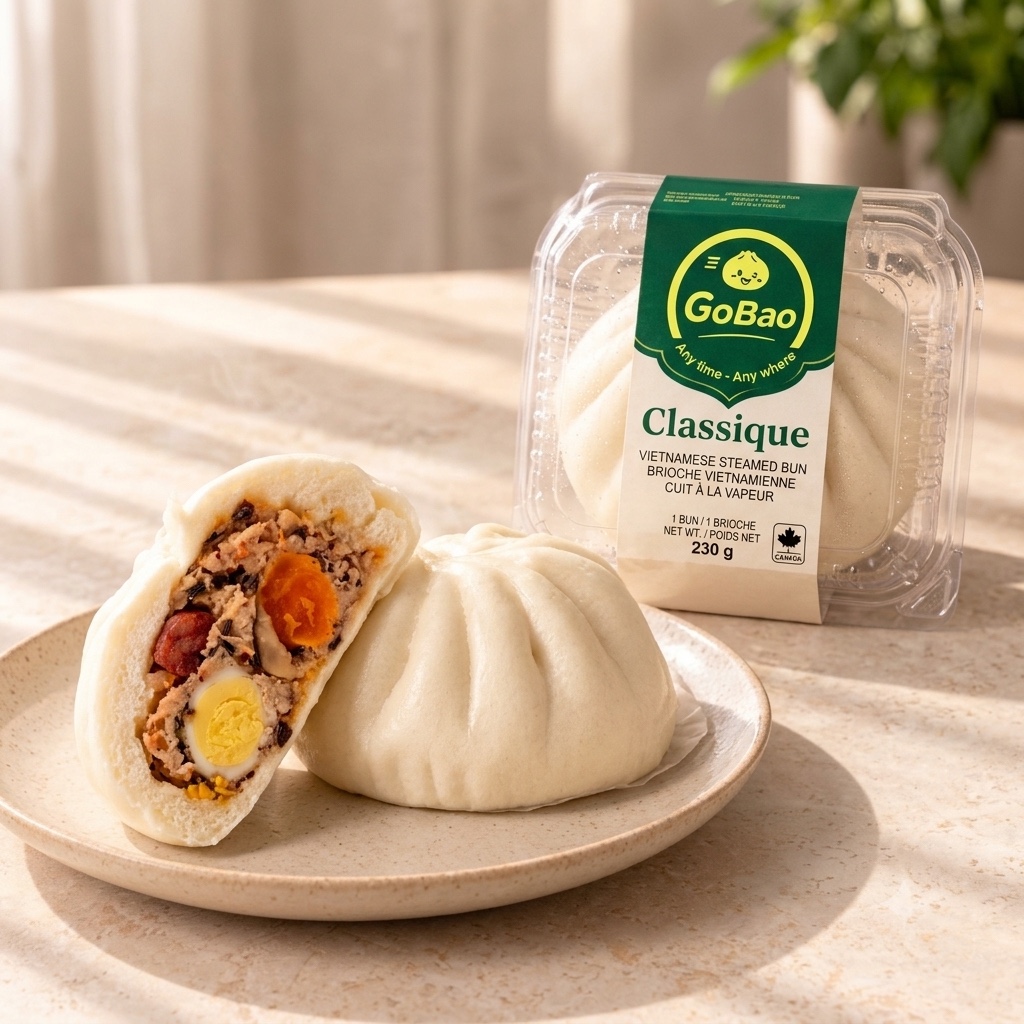
Banh bao and baozi are both soft, steamed, filled buns — which is exactly why they’re easy to confuse. Side by side, though, they come from different traditions and are built differently. Here’s how to tell them apart.
What banh bao is
Banh bao is the Vietnamese steamed bun: a round, fully sealed bun with a savory filling, most often seasoned ground pork with a hard-boiled quail or chicken egg inside. See What Is Banh Bao? for the full breakdown.
What baozi is
Baozi is the broad Chinese family of steamed filled buns — a huge category with many shapes, sizes, and fillings, both savory and sweet. Char siu bao (barbecued pork) is the best-known example, but baozi range from pork and vegetable to sweet red bean and custard.
The dough
Both use a leavened wheat-flour dough, but banh bao’s dough is often lighter and slightly sweeter, steamed to a bright, pale finish. Baozi dough varies more widely by region and filling, from fluffy dim sum buns to denser home-style versions.
The filling
This is where they diverge most clearly:
- Banh bao — seasoned ground pork, usually with onion, plus add-ins like wood ear mushroom, Chinese sausage, or salted egg yolk. The signature is the hard-boiled egg tucked inside, and the seasoning leans on fish sauce for umami.
- Baozi — a far wider range. Pork baozi may use minced or diced pork, often with cabbage, scallion, or ginger, and char siu bao uses sweet barbecued pork in a sticky sauce.
The egg — banh bao’s signature
The fastest way to tell a banh bao from most baozi is the egg. Many banh bao contain a hard-boiled quail or chicken egg inside the pork — a detail that’s rare in baozi. Not every banh bao has one, but when you see the egg, it’s a strong signal you’re looking at the Vietnamese version.
Quick comparison
| Banh Bao | Baozi | |
|---|---|---|
| Origin | Vietnam | China |
| Category | One specific bun | A broad family of buns |
| Shape | Round, fully closed | Many shapes and sizes |
| Classic filling | Seasoned ground pork, often with egg | Varies — pork, char siu, sweet, vegetable |
| Signature detail | Hard-boiled egg inside | Varies by style |
How to tell them apart
- Look for the egg — it’s the clearest banh bao signal.
- Check the filling — seasoned ground pork with fish sauce points Vietnamese; sweet barbecued pork points char siu bao.
- Check the label — banh bao is one specific bun; baozi is a whole category, so a specific name usually tells you more.
The wider bao family
Banh bao and baozi sit inside a larger family of steamed buns. Beyond them: gua bao (Taiwan’s flat, folded bun — see the banh bao vs gua bao comparison), nikuman (Japan), and siopao (Philippines). Banh bao is the Vietnamese member of that family, and the egg inside is its clearest calling card.
Fresh vs frozen: what to check
Bao buns are sold fresh and refrigerated for short-term use by some makers, and frozen for longer storage by others. Check the package rather than assuming. GoBao’s buns are a fresh, refrigerated product kept at 0-4°C — if you’re reheating at home, see how to reheat banh bao.
FAQ
Are banh bao and baozi the same thing?
No. Baozi is a broad Chinese family of steamed filled buns; banh bao is one specific Vietnamese style within that wider tradition.
Does every banh bao have an egg?
Many do, but not all. It’s a common signature, not a universal rule.
Is char siu bao the same as banh bao?
No. Char siu bao is a Chinese bun filled with sweet barbecued pork, while banh bao is Vietnamese with seasoned ground pork and often an egg.